Editorial Policy
The journal’s aims, peer review procedure, open access policy and publication ethics.
On this page
Journal Concept and Aims
Journal Concept and Aims
The journal was founded in 1998 by researchers from the Ministry of Education and Science of the Altai Republic and Gorno-Altaisk State University, under the leadership of Anatoly Viktorovich Petrov, Doctor of Sciences in Education and Professor. Its first Editorial Council brought together senior scholars and professors from Moscow, Novosibirsk, Tyumen, Vladivostok, Yekaterinburg, Chelyabinsk, Kirov, Saint Petersburg and Sochi.
The journal is an international scholarly publication, registered with the ISSN International Centre in Paris in 2000. It was registered as a Russian mass media outlet in 2003 under certificate PI No. 77-14649 of 17 February 2003, followed by PI No. FS 77-49955 of 23 May 2012. It has been included in the Russian Higher Attestation Commission’s list of leading peer-reviewed periodicals since 2007 and is also included in the Russian Science Citation Index (RSCI). The journal is listed in Ulrich’s Periodicals Directory. The journal also hosts international conferences on current research issues. A scientific council works on a voluntary basis at these events, hearing presentations of doctoral research. Conference proceedings are indexed in the RSCI, and each participant receives a personalised certificate free of charge.
The journal primarily publishes research articles and scholarly reviews. The editorial office supplies mandatory copies of the journal in accordance with Russian legislation. It is published every two months, with six issues per year, and covers education and philology. Its expert assessment body arranges manuscript reviews by subject specialists. Review reports are retained for five years. Authors are informed of the review findings and receive comments and recommendations for revision or a reasoned rejection. The official website is available in Russian and English and provides public information about the publisher, Editor-in-Chief, International Advisory Council and Editorial Board, including members’ academic degrees and titles. The information letter sets out contact details, the journal’s scope, manuscript submission, review and publication procedures, and requirements for reference lists, abstracts and keywords. Full issue texts from 2007 onwards are freely available in the All Issues section. All issues have been supplied to the RSCI since 2008. The journal’s ISSNs are 1991-5497 for print and 1991-5500 for the online edition.
The World of Science, Culture and Education aims to improve the quality of research by encouraging professional and public discussion of its findings. It seeks better ways to present research and timely information, broaden the geographical range of the issues covered and strengthen links with the international humanities community. Its editorial policy takes an integrated, systematic approach, bringing the work of research groups and individual scholars to academic and educational audiences. These contributions share a common purpose: addressing pressing problems in science and education.
To put these aims into practice, the editorial office pursues the following activities:
1. Engage leading Russian and international scholars in supporting research in Russia and encourage their creative collaboration.
2. Facilitate professional exchange among researchers and practitioners in education, psychology and philology; present new organisational, psychological and philological research; promote the practical use of new research and applied developments in educational institutions; and involve early-career colleagues in professional discussion.
3. Use editorial and publishing outreach to meet three professional objectives: satisfy the information needs of the journal’s authors, create conditions for its qualitative development, and sustain the productive work of the journal and its editorial office.
4. Bring together researchers from different countries to improve the exchange of research experience, in keeping with the journal’s central purpose.
To achieve this, the editorial office must ensure:
• regular publication in print and online;
• open access to journal articles on the publisher’s website;
• financial independence;
• broad geographical representation on the International Advisory Council, within Russia and internationally;
• rigorous review of every article by specialists in the relevant field;
• compliance with Russian and international requirements for comparable publications;
• publication of previously unpublished articles and original research that may form the basis of future dissertations;
• contributions from leading specialists in the journal’s fields.
5. Uphold scholarly rigour, objectivity and professionalism; support the dissemination of significant educational and specialist innovation research; and observe publication ethics.
6. Support the continuing work and development of the International Advisory Council, Editorial Board, expert assessment body and section editors. This work involves qualified specialists, including scholars holding Doctor or Candidate of Sciences degrees, professors and other researchers with experience in research and academic publishing.
7. Promote the journal’s development, improve access to its content and extend its presence in scholarly information resources. The journal’s content is published in open access.
8. Hold international conferences on current research issues, supported by a voluntary scientific council that hears presentations of dissertation research, offers recommendations and helps researchers establish links with other research groups. The editorial office regards this as an important form of professional and public discussion of research findings, a way to improve dissertation quality within the journal’s activities, and a means of assessing the journal’s effectiveness. These events draw on the expertise of participating scholars.
The journal advances research in education and philology and seeks to deepen international understanding of Russian scholarship in these fields. In selecting articles, priority is given to new historical and literary sources, scholarly rigour and objectivity, comprehensive engagement with historiography, and substantive academic debate. The Editorial Board includes internationally recognised scholars. All articles undergo peer review. The journal appears every two months. Russian is the main language of publication, with articles also published in English and other languages.
The Editorial Board welcomes contributions that combine new sources on the past and present with constructive reassessment of established frameworks, new concepts and a diversity of approaches. Researchers from outside Russia have the same opportunities to publish as their Russian colleagues. Closer interaction between scholarly traditions is productive and helps guard against falsification and unsupported conclusions. The Editorial Board and Editorial Council include leading Russian and international scholars, and articles are reviewed by highly qualified specialists.
All members of the International Advisory Council and Editorial Board hold senior doctoral degrees and professorial titles. Their research represents substantial scholarly achievement and addresses significant problems in their respective fields. Membership is therefore based on the following requirements: 1) a Doctor of Sciences degree, reflecting major independent research or a substantial body of research; 2) international academic mobility and the ability to build research connections; 3) an understanding of the social role of scholarly publishing; 4) the ability to organise and plan journal work; 5) the ability to structure information in accordance with international publishing requirements; 6) the ability to analyse submissions and identify current issues for conferences organised by the journal; 7) the ability to communicate research in an appropriate language and form; 8) the ability to assess publishing outcomes and take responsibility for them; 9) readiness to work as part of an editorial team; 10) active research, publication and supervision of postgraduate and doctoral researchers; 11) active participation in public dissertation defence councils at the journal’s international academic conferences; and 12) diligence and initiative.
Journal policy
Journal policy
The journal must have a clearly defined policy setting out its aims, objectives, subject areas and peer review system, together with its existing geographical diversity, or plans to broaden that diversity, among the International Advisory Council, Editorial Board and authors. The following principles apply:
1. The journal’s subject matter must be current, offer new insights and interest an international readership. It should not be confined to a narrow regional audience or a limited group of specialists. Its scope should also take account of national interests.
2. The journal should provide opportunities to expand international contacts and participate in international projects and programmes, strengthen its international influence, attract authors from other countries and consider publishing English translations of articles.
3. The journal sets requirements for authors and reviewers and uses double-blind peer review. Reviewers are not told the authors’ identities, and authors are not told the reviewers’ identities. Assessment by the Editor-in-Chief does not replace independent peer review.
Peer review is central to the development of a scholarly journal and must ensure a consistent standard of research quality. When genuine expert assessment is absent, or review is merely a formality conducted by a single editor, the quality of articles can vary widely even in journals with otherwise respectable overall indicators.
4. The International Advisory Council and Editorial Board must comprise well-qualified scholars from different regions of Russia. International membership is encouraged. Researchers from the journal’s own institution should account for no more than 30% of members.
5. The journal should attract well-qualified authors, including postgraduate and doctoral researchers, established scholars, holders of Doctor and Candidate of Sciences degrees, professors and associate professors. In each issue, authors from any one institution should account for no more than 30% of the total.
6. The journal must be scholarly in character, with 85–90% of its content consisting of original research articles not previously published elsewhere in the same language, and scholarly review articles. Manuscript length is governed by the current information letter and manuscript requirements available in the For Authors section.
7. The journal has been published since 1998.
Journal Development Programme
Journal Development Programme
To improve the journal, the editorial office develops its scholarly assessment, international cooperation and access to publications. Priorities include the scholarly value of manuscripts, rigorous peer review and accurate bibliographic information.
The editorial office’s planned actions include:
• increasing the proportion of articles by international authors and jointly authored international publications;
• attracting highly cited authors by identifying leading scholars in the journal’s fields and inviting their contributions;
• increasing the proportion of review articles;
• strengthening the International Advisory Council and Editorial Board by identifying and recruiting highly cited scholars, including researchers from other countries;
• improving peer review by engaging internationally recognised experts and maintaining a database of external reviewers;
• providing English contents pages, informative article titles, complete author details, English abstracts and keywords, and accurate reference lists appropriate to the discipline, including a reference list in the Latin alphabet;
• improving print and digital production quality;
• developing the online edition through additional media, including article data, tables, figures and videos on the website;
• introducing author feedback to assess satisfaction with the journal’s work;
• creating electronic archives with full-text search;
• improving distribution channels.
The World of Science, Culture and Education should remain openly accessible, reach as many relevant institutions as possible, including those abroad, and provide open archives of earlier years. Subscription publications should seek to increase subscriptions within Russia. Free distribution should also be planned to make the journal better known to its scholarly community.
Peer Review Procedure
Peer Review Procedure
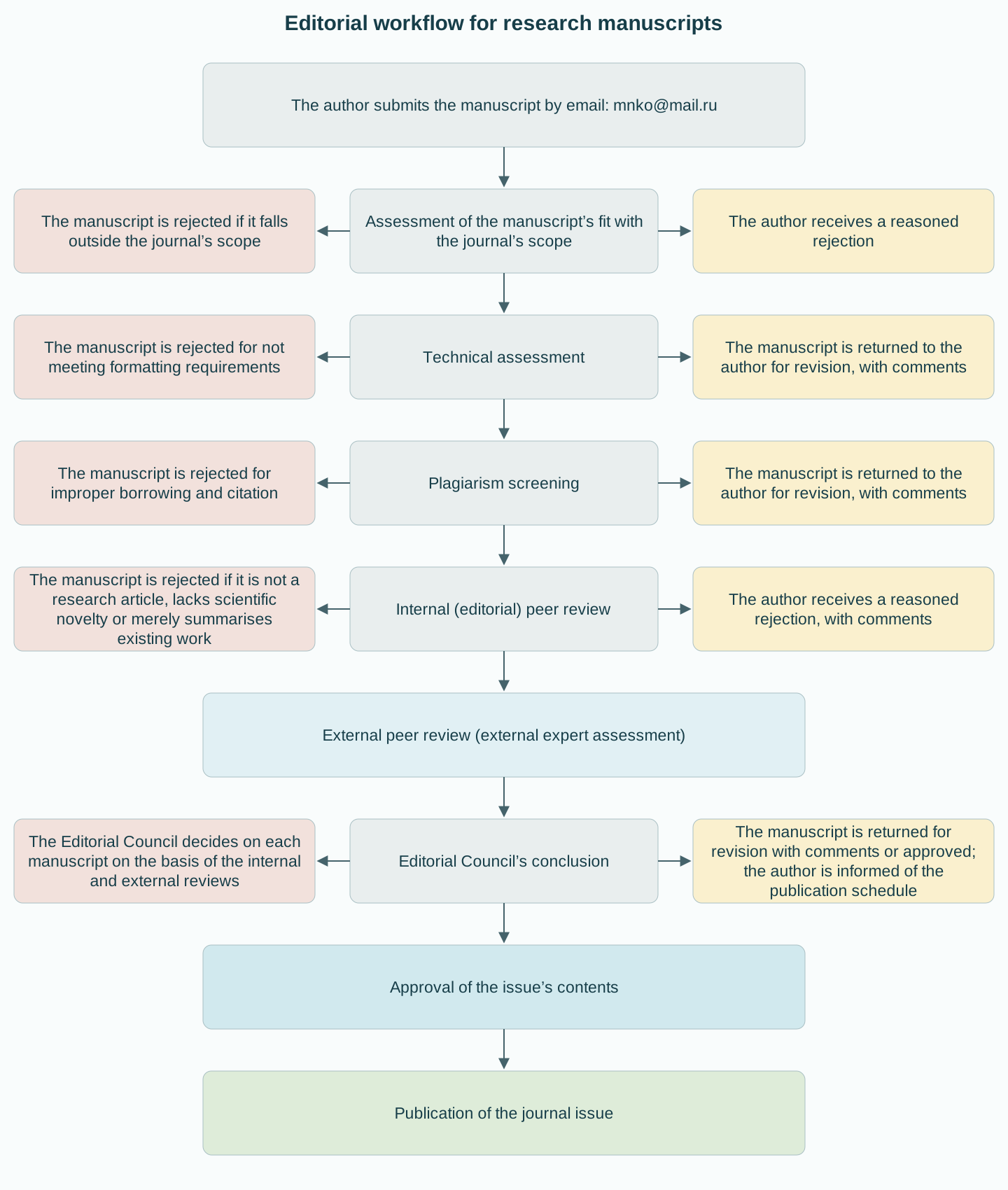
All submitted articles undergo mandatory external double-blind peer review. The reviewer is not told the author’s name, and the author is not told the reviewer’s name.
On receipt, the editorial office checks whether the manuscript fits the journal’s scope, includes the required metadata, meets the formatting requirements and contains suitable illustrations. The manuscript is then anonymised by removing all indications of authorship. The editorial office sends it for external peer review to independent subject specialists holding Doctor or Candidate of Sciences degrees. Each manuscript is assessed by at least three reviewers. The expert assessment body organises external review.
Reviewers assess compliance with the journal’s substantive and formal requirements and with generally accepted publication ethics. The manuscript may be accepted without substantial revision, accepted subject to amendments and corrections, or rejected.
After peer review, the author receives copies of the review reports with all information that could identify the reviewers removed. If the article is rejected, the author receives a reasoned rejection. If the article is rejected before peer review, the editorial office explains the reason for its decision.
If acceptance is conditional on additions and corrections, the author is sent a list of required changes. After revision, the manuscript may be resubmitted; it is normally assessed by the same reviewers as on the first submission.
If the article is accepted for publication, the text is passed to the scientific editor, who then corresponds with the author.
Positive review reports do not constitute sufficient grounds for publication. The final decision on publication is made by the Publisher, taking the results of scientific assessment into account. The author is informed of the issue in which the article is to appear.
Publication Frequency
Publication Frequency
The journal publishes six issues a year, at the end of February, April, June, August, October and December. Submissions are accepted throughout the year without restriction.
Open Access Policy
Open Access Policy
Journal articles are freely available to all readers. This policy reflects the principle that open access to research findings makes relevant information easier to discover and supports the global exchange of knowledge.
Articles published in the journal in all years, including back issues, are distributed under the Creative Commons Attribution 4.0 International licence (CC BY 4.0): https://creativecommons.org/licenses/by/4.0/.
The licence permits copying, redistribution, translation and other adaptations, including commercial use, subject to its terms: attribution of authorship, source and licence, retention of supplied copyright notices, and indication of changes made.
Third-party materials not covered by this licence are identified separately. Their inclusion in an article does not in itself grant permission for reuse.
The electronic edition of the journal may be distributed through its official website and mobile application. By submitting an article, the author grants RMNKO LLC the right to reproduce it in the electronic edition of the journal and make it available through these channels under the publication terms.
Publication Ethics
Publication Ethics
STATEMENT
BY THE EDITORIAL OFFICE OF THE INTERNATIONAL JOURNAL
THE WORLD OF SCIENCE, CULTURE AND EDUCATION
ON PUBLICATION ETHICS AND MALPRACTICE
The future of research and scholarly publishing depends not only on compliance with laws and regulations, but also on ethical relationships within the research and publishing communities. These principles help increase the number of high-quality publications and support productive cooperation among authors, publishers and readers.
The International Advisory Council and Editorial Board of The World of Science, Culture and Education follow internationally accepted principles of publication ethics, including the recommendations of the Committee on Publication Ethics (COPE) and the Code of Ethics for Scientific Publications. Their work is also guided by Chapter 70, “Copyright”, of the Civil Code of the Russian Federation and by the experience of respected international journals and publishers.
To prevent malpractice, including plagiarism and the presentation of unreliable information, and to ensure high-quality publications and appropriate recognition of research findings, every editor, author, reviewer, publisher and participating institution must observe ethical standards and take all reasonable steps to prevent violations. Adherence to these principles protects authors’ intellectual property, improves publication quality and prevents the misuse of their work for personal advantage.
Responsibilities of authors
Authors submitting to The World of Science, Culture and Education must respond to reviewers’ comments and address the shortcomings identified, or provide a reasoned defence of their position. If a disagreement arises, they may submit specific objections to the editorial office or withdraw their manuscript.
Authorship should be limited to those who have made a significant contribution to the research findings presented in the article.
The article’s main content must not have been published in another journal. Authors must follow the relevant instructions and citation rules. Their submission must state that the manuscript is not plagiarised and that all reported data are real and authentic.
Responsibilities of the Editor-in-Chief
The Editor-in-Chief is responsible for the journal’s content and the quality of its articles. All submissions must be assessed objectively, with conflicts of interest avoided in acceptance and rejection decisions. Selection must take account of relevance, originality, scholarly significance, clarity, the reliability of results and the completeness of conclusions. Research quality and relevance form the basis of publication decisions.
The Editor-in-Chief must preserve the anonymity of authors and reviewers throughout peer review.
The Editor-in-Chief is responsible for the scholarly and editorial assessment of manuscripts. The final decision on publication is made by the Publisher.
Complaints concerning reviewed manuscripts or published material must receive a response. When a dispute arises, the Editor-in-Chief must take the steps necessary to restore any rights that have been infringed.
Responsibilities of reviewers
Reviewers must provide an objective assessment.
Reviewers must not misuse information contained in a manuscript for personal or other advantage.
A reviewer may decline an assignment because of competing professional interests, including:
• professional or personal benefit arising from the acceptance or rejection of the article;
• fundamental disagreement on the article’s central subject;
• close professional or personal relationships with an author or any member of the author team.
If a reviewer does not decline an assignment on these grounds, the Editor-in-Chief assumes that no conflict of interest exists.
Reviewers should identify relevant published work that the authors have not cited.
Responsibilities of Editorial Board Members
• Take responsibility for material published in their respective subject areas.
• Make fair, impartial decisions independent of commercial interests and organise objective peer review.
• Uphold an editorial policy that provides maximum transparency and full accountability to authors.
• Protect the integrity of publications, issue corrections when necessary and provide reasoned rejections when manuscripts do not meet research or publication ethics standards.
• Protect third-party rights against unauthorised use of material.
• Manage editorial conflicts of interest.
• Critically assess the ethical standards of research involving humans and animals.
Ensure that authors and reviewers understand what is expected of them.
Publication Ethics
Publisher: ООО «РМНКО» (RMNKO LLC). INN 0411150450, OGRN 1100411002120.
The publisher supports and invests in scholarly communication and is responsible for ensuring that published work complies with current publication ethics recommendations.
The publisher takes appropriate action in response to ethical complaints about submitted manuscripts or published material. This generally involves contacting the authors and considering the grounds for the complaint or request; it may also involve relevant organisations and research centres.
The publisher seeks to ensure that commercial interests do not influence editorial decisions.
The publisher cooperates with other publishers and professional associations on ethical issues, the detection of errors and the publication of retractions or rebuttals.
Conflicts of interest
Any alleged breach of publication ethics by an editor, author or reviewer must be investigated, whether the material has been published or remains unpublished. The Editorial Board must seek explanations without involving anyone who may have a conflict of interest with either party. If published material contains significant inaccuracies, it must be corrected promptly in a form accessible to readers and indexing services.
The editorial office of The World of Science, Culture and Education undertakes to uphold:
ethical standards of authorship;
ethical standards of peer review;
ethical standards of editing;
ethical standards of publishing.
Materials must be submitted by an author or a co-author designated as the corresponding author. The editorial office does not work with commercial intermediaries arranging publication. With the editorial office’s agreement, an author may appoint an assistant to transmit files and deal with organisational matters, confirming the appointment from the author’s own email address. Manuscript content, publication terms and author declarations must be agreed directly with the author.
An author appointing an assistant must provide the assistant’s full name, contact email address and the nature of the assistance. An assistant must not impersonate an author or a representative of the editorial office. If there are reasonable doubts about the assistant’s authority, work on the materials is suspended pending confirmation from the author. If documents, signatures or confirmation of authority are found to be forged, the editorial office may decline consideration and cease dealing with the assistant. The author is given an opportunity to explain and contact the editorial office directly.
Authors confirm the accuracy of information about themselves, including academic degrees, academic titles, positions and affiliations, and are responsible for the information they provide. The editorial office may request supporting evidence, suspend consideration or decline publication if inaccurate information is identified. After publication, the need for a correction or retraction is assessed in light of the nature of the issue.
Authors must disclose research funding and circumstances that could influence the content or assessment of the research. For studies involving human participants, information about ethical approval and participant consent must be provided where applicable. Reasoned requests concerning editorial decisions should be sent by email: mnko@mail.ru.
Authors who need assistance with formatting and preparing an article for consideration may contact the editorial office directly by email: mnko@mail.ru. The availability, scope and terms of support are discussed individually. Support does not guarantee acceptance for publication.
Text Overlap and Plagiarism
Text Overlap and Plagiarism
The proportion of matching text reported by the screening system must not exceed 15%. This threshold does not permit plagiarism: quotations and borrowed ideas must be properly presented and accompanied by references to their sources.
When assessing a manuscript, the Editorial Board may check it using the Antiplagiat system. If substantial unattributed borrowing is found, the editorial office follows COPE guidance.
Use of artificial intelligence
Authors are prohibited from using AI when conducting research and preparing submitted materials. This includes collecting and analysing data; creating, revising, translating, editing or proofreading text; and preparing references, tables and illustrations.
The editorial office may use AI solely for technical and language processing of manuscripts under specialist supervision, while preserving the authors’ intent, scientific content and conclusions and ensuring the confidentiality of the materials. Scientific assessment and publication decisions are carried out by people.
AI may be a subject of research: authors may analyse published sources and documented examples of its operation, with appropriate source attribution. This does not permit the use of AI as a research tool, including running AI systems to obtain experimental results.
An established violation results in rejection, regardless of the extent of AI use or subsequent revision of the materials. The journal will not accept new submissions for two years from the date of the decision from an author whose involvement in the violation or knowingly false declaration has been established. This restriction does not automatically extend to other co-authors.
Before a decision is made, the author is given an opportunity to provide an explanation. An automated detection result alone does not establish a violation. The author is informed of the decision and its grounds; the decision is reconsidered if an error is identified.
Information about violations is recorded internally. Lists of authors are neither published nor shared with other editorial offices.
Journal Indexing
Journal Indexing
Information about the journal’s indexing and relevant bibliographic resources is provided below. Links to the journal’s records are available in the About the Journal section.
The Russian Science Citation Index (RSCI) is a bibliographic and abstracting database of publications by Russian researchers in Russian and international scholarly journals. The Scientific Electronic Library (eLIBRARY.RU) has developed the project since 2005.
Ulrich’s Periodicals Directory (Ulrichsweb) is an international directory of serial publications. It provides bibliographic information about publications, publishers, publication frequency, formats and other characteristics.
CyberLeninka is an open-access scholarly library that promotes science and research, public scrutiny of publication quality, interdisciplinary research, modern peer review and the citation of Russian scholarship. Its work is based on the principles of open science.
Founder
Founder
ООО «РМНКО» (RMNKO LLC).
Author Affiliation
Author Affiliation
Why does complete affiliation information matter?
What does an author’s affiliation mean in English?
An affiliation identifies the organisation with which an author is associated in relation to the research presented. It connects the publication with its author and institution and should include the institution’s full official name, city and country.
Why affiliation matters to authors and journals
Incomplete or inaccurate affiliations can make it difficult to identify the author and record the publication correctly in information systems. Authors should check these details when preparing their manuscript and reviewing material for publication.
What an affiliation should contain
An English-language affiliation should include the complete address of the organisation where the author currently works. It should also identify all workplaces at which the research was conducted, including the author’s permanent institution and any project-based workplace.
Author information should include position, academic titles and institutional affiliation, with fuller details where appropriate. A statement of each author’s contribution may optionally appear at the end of the article or in a footnote.
References
References
The main purposes of a reference list
Helping your article through peer review in journals covered by international databases
The English-language elements of an article
A reference list identifies the sources underpinning the research and enables readers to check citations and locate the works used. Complete and accurate bibliographic descriptions help readers and support reliable citation records.
Three Purposes of a Reference List
A reference list serves three main purposes: acknowledging the sources used, helping readers locate them and showing the scholarly basis of the research.
First, a reference list acknowledges other authors’ ideas and helps prevent plagiarism. Second, it enables readers to locate the cited sources, consult the original material and check the evidence. Third, it demonstrates the depth and breadth of the author’s research.
Why references in the Latin alphabet matter
When preparing an English-language reference list, authors should reproduce source details accurately. A reference connects the publication with the work it cites and helps readers locate and identify that source.
Transliteration standards and styles
Russian-language sources included in an English-language reference list should follow the journal’s requirements. Authors should use the chosen transliteration system consistently and preserve accurate details of authors, titles, publications, years, pages and source identifiers.
Self-citation
Self-citation is permitted where the previous work is directly relevant to the research. Adding citations solely to increase citation metrics is not permitted. Legal and regulatory documents should be cited where they are necessary to support the research.
Scholarly Information Resources and Catalogues
Scholarly Information Resources and Catalogues
The following are examples of scholarly information resources and catalogues. Their inclusion in this list does not mean that the journal is listed in each of them. Ulrich’s Periodicals Directory is an international directory of serial publications.
Electronic catalogues, including WorldCat–OCLC.
Open-access full-text resources, including DOAJ, arXiv.org, RePEc and IDEAS.
Full-text aggregation platforms, including EBSCO, ProQuest, EconLit and CEEOL.
The editorial office considers opportunities to extend the journal’s presence in relevant scholarly resources.
An ISSN is an International Standard Serial Number. The journal’s print edition has ISSN 1991-5497, and its online edition has ISSN 1991-5500. ISSNs identify serial publications and their bibliographic records in the ISSN Register. Having an ISSN does not, in itself, mean that every article in the journal is indexed in scholarly citation databases.